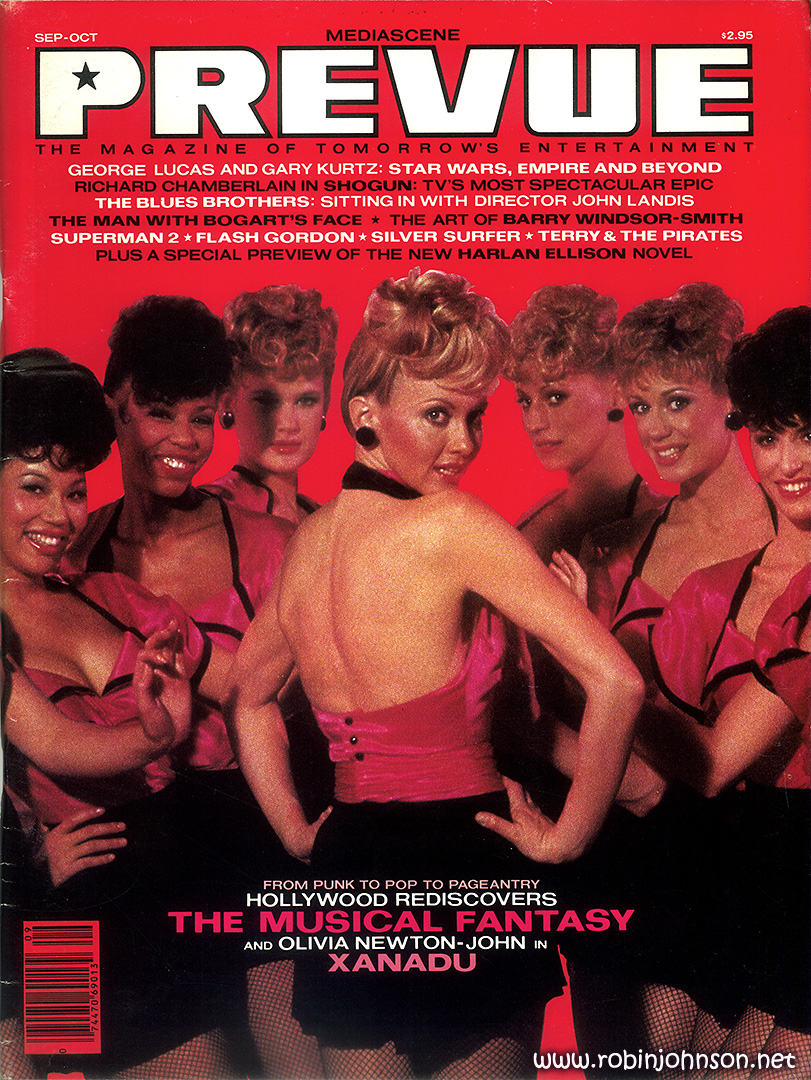
Magazines are dated ahead by their publishers to try to keep them on the stands longer than their competitors. The date on a magazine usually refers to when it is supposed to be replaced by the next issue, not when it actually comes out. Anyway, although this issue of Prevue was probably still current when Times Square opened in October 1980, “Musicals” by Jim Burns is another case of an article having been written months before publication, before Associated Film Distributors and RSO has designed their marketing plan.
The two photos accompanying the article are the same ones that had been used by The Aquarian back in April, although they’re cropped differently: there’s more of Robin and Trini, and a bit less of Tim. Along with the shot of Nicky with microphone in the Cleo Club, these were the first images released to the press, but they weren’t included later in the official press kit.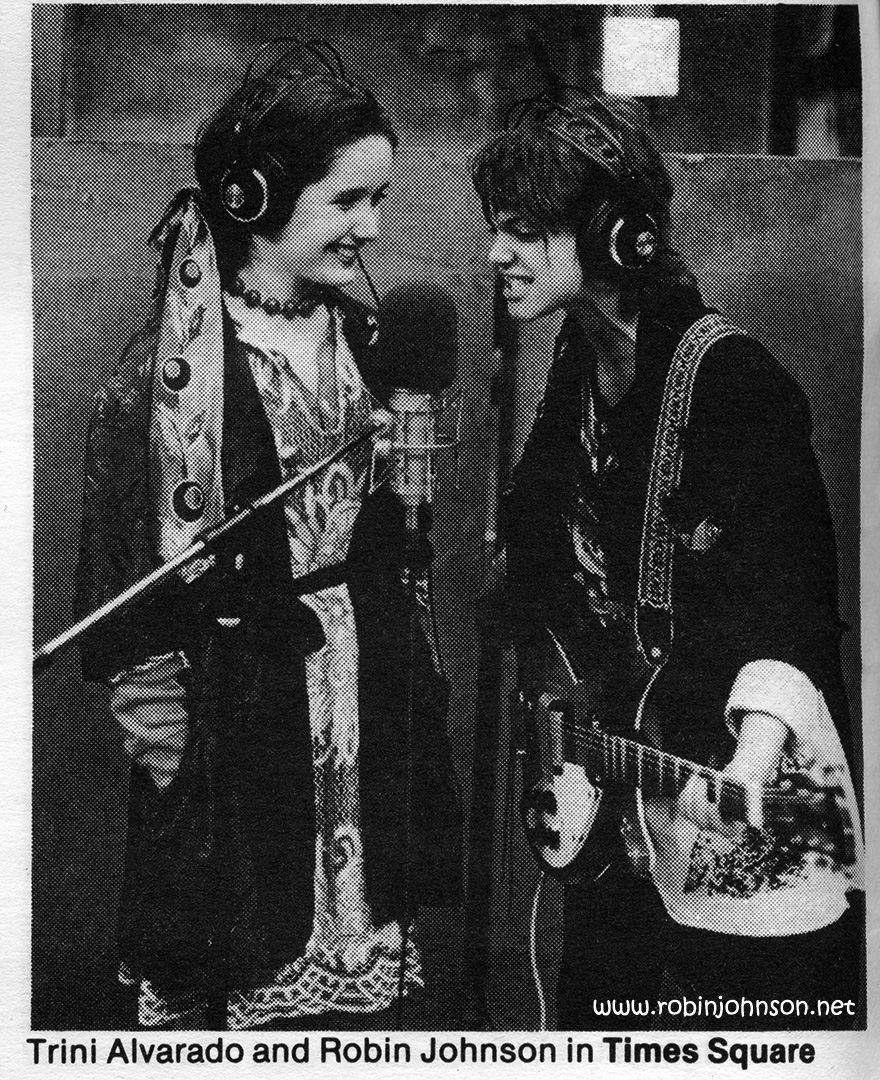
The article describes Times Square as a product of Robert Stigwood’s media powerhouse, but also features Allan Moyle defending what remained of his original vision for perhaps the last time in the press: “Times Square isn’t a punk picture,” he says. “The girls’ particular rebellion or societal anger has to do with their own little heads. They’re not making any statement; they’re just two runaways.”
That much is certainly true: Times Square was not conceived as a story that takes place within an environment where New Wave rock is actively being created, as opposed to films like Breaking Glass (1980) and Ladies and Gentlemen, the Fabulous Stains (1982) (but shot mostly in 1980), where the main characters deliberately set out to start bands and are surrounded by other bands. If it had been, the location would probably have been moved to CBGBs and the title changed to The Bowery. Nicky’s spirit and determination to do everything herself at whatever cost, however, fit in perfectly with punk’s DIY ethos.
But he then goes on to say, “New Wave music was in our script from the very beginning, before we had had any contact with the Stigwood Organization. The music is keyed to the texture of the screenplay.” Although we don’t know exactly when the soundtrack became a vehicle for New Wave music, we do know that in the original script the soundtrack was Classic Rock, Adult Contemporary, Disco, and Oldies. The closest thing to New Wave was “Sweet Jane” by the Velvet Underground. While it is entirely possible that Moyle and Jacob Brackman had started changing the music before Stigwood got his hands on the script, I believe that changing the focus of the soundtrack was Stigwood’s idea. It was a deliberate attempt to cater to a new segment of the market; as much of the publicity material says, to make a New Wave Saturday Night Fever. It may have been a cynical business-driven move, but it improved the film no end. Although it does create the strange situation of New Wave music being everywhere while there are almost no visible signs of the city’s vibrant punk scene that hadn’t yet started to fade.
Finally, the article states, “Despite Moyle’s claim that Times Square isn’t a ‘punk picture,’ the film’s soundtrack will offer seven New Wave songs, including Desmond Child and Rouge’s ‘The Night is Not,’ Tom Petty’s ‘Refugee’ and Talking Heads’ ‘Life During Wartime.'” That one sentence contains three facts proving how long before publication it was written. First: Allan Moyle had not yet been fired for refusing to cut scenes in order to accommodate more music. Second: seven New Wave songs? The final soundtrack album contains 20 songs, at least 12 of which are New Wave (depending on how much of a pedant you are over the definition of “New Wave”), plus one more song that didn’t make the album. So, this was also before Stigwood had the idea to produce a double-album, thus necessitating the cuts to add more music. And third: Tom Petty? Again with the Tom Petty? Now I dimly remember that when “Refugee” first came out, Tom Petty was marketed as being something of a New Wave act (although of course he wasn’t), and “Refugee” does seem to be a good thematic fit for Times Square, but why were they so insistent for so long that it was going to feature in the soundtrack? Might it have had something to do with Robert Stigwood putting Bill Oakes and Jimmy Iovine in charge of assembling the soundtrack? Jimmy Iovine, who in 1979 co-produced Tom Petty’s Damn the Torpedoes album? That album came out as Times Square started shooting. The single reached #15 in January 1980. It probably seemed like an obvious and easy choice for Iovine to shepherd a cross-promotion deal with a major motion picture whose soundtrack he was putting together. Luckily for all of us, though, the deal fell through. I like “Refugee” but it belongs on the Times Square soundtrack even less than “Help Me!”
tl;dr: “Does Times Square merely use New Wave in the same way that Stigwood highlighted disco in Saturday Night Fever?” the article asks. The answer at the time: Not yet, but just you wait.
(One last piece of evidence of how early the article was written: RSO hadn’t yet removed one of the L’s from Allan Moyle’s first name.)
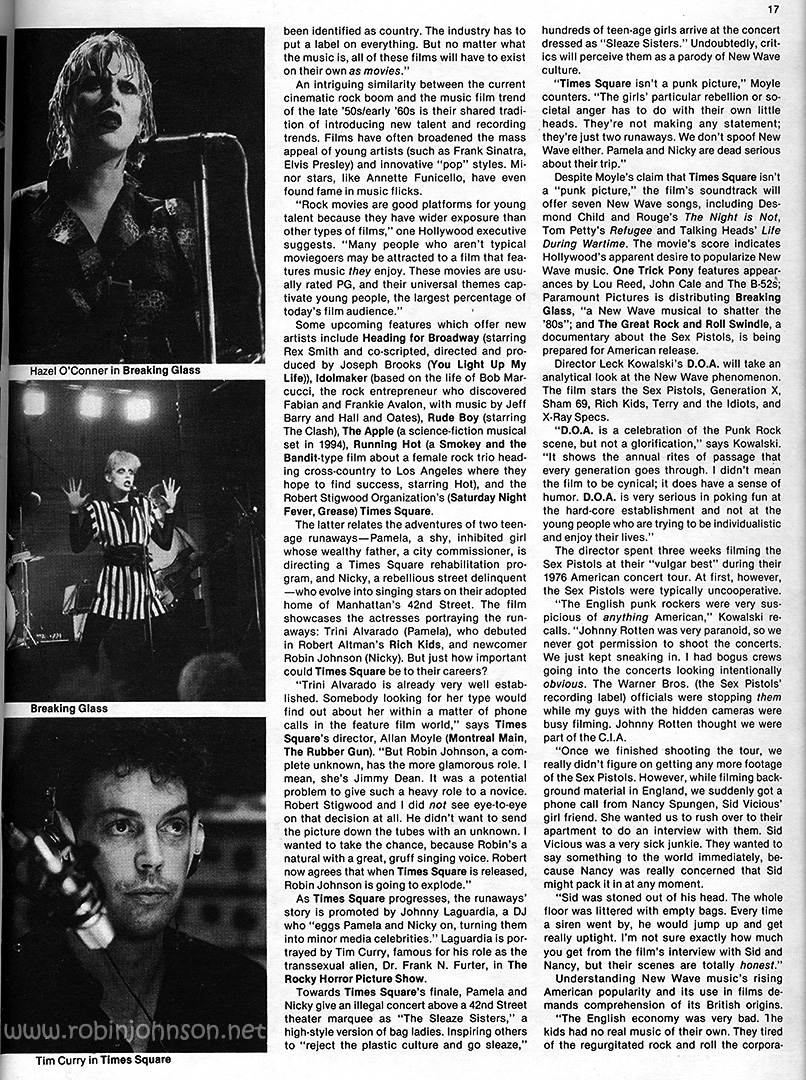
Here’s the Times Square material from the article, so you don’t have to strain your eyes:
Some upcoming features which offer new artists include Heading for Broadway (starring Rex Smith and co-scripted, directed and produced by Joseph Brooks (You Light Up My Life)), Idolmaker (based on the life of Bob Marcucci, the rock entrepreneur who discovered Fabian and Frankie Avalon, with music by Jeff Barry and Hall and Oates), Rude Boy (starring The Clash), The Apple (a science-fiction musical set in 1994), Running Hot (a Smokey and the Bandit-type film about a female rock trio heading cross-country to Los Angeles where they hope to find success, starring Hot), and the Robert Stigwood Organization’s (Saturday Night Fever, Grease) Times Square.
The latter relates the adventures of two teenage runaways — Pamela, a shy, inhibited girl whose wealthy father, a city commissioner, is directing a Times Square rehabilitation program, and Nicky, a rebellious street delinquent — who evolve into singing stars on their adopted home of Manhattan’s 42nd Street. The film showcases the actresses portraying the runaways: Trini Alvarado (Pamela), who debuted in Robert Altman’s Rich Kids, and newcomer Robin Johnson (Nicky). But just how important could Times Square be to their careers?
“Trini Alvarado is already very well established. Somebody looking for her type would find out about her within a matter of phone calls in the feature film world,” says Times Square’s director, Allan Moyle (Montreal Main, The Rubber Gun). “But Robin Johnson, a complete unknown, has the more glamorous role. I mean, she’s Jimmy Dean. It was a potential problem to give such a heavy role to a novice. Robert Stigwood and I did not see eye-to-eye on that decision at all. He didn’t want to send the picture down the tubes with an unknown. I wanted to take the chance, because Robin’s a natural with a great, gruff singing voice. Robert now agrees that when Times Square is released, Robin Johnson is going to explode.”
As Times Square progresses, the runaways’ story is promoted by Johnny Laguardia, a DJ who “eggs Pamela and Nicky on, turning them into minor media celebrities.” Laguardia is portrayed by Tim Curry, famous for his role as the transsexual alien, Dr. Frank N. Furter, in The Rocky Horror Picture Show.
Towards Times Square’s finale, Pamela and Nicky give an illegal concert above a 42nd Street theater marquee as “The Sleaze Sisters,” a high-style version of bag ladies. Inspiring others to “reject the plastic culture and go sleaze,” hundreds of teen-age girls arrive at the concert dressed as “Sleaze Sisters.” Undoubtedly, critics will perceive them as a parody of New Wave culture.
“Times Square isn’t a punk picture,” Moyle counters. “The girls’ particular rebellion or societal anger has to do with their own little heads. They’re not making any statement; they’re just two runaways. We don’t spoof New Wave either. Pamela and Nicky are dead serious about their trip.”
Despite Moyle’s claim that Times Square isn’t a “punk picture,” the film’s soundtrack will offer seven New Wave songs, including Desmond Child and Rouge’s The Night is Not, Tom Petty’s Refugee and Talking Heads’ Life During Wartime. The movie’s score indicates Hollywood’s apparent desire to popularize New Wave music.
…
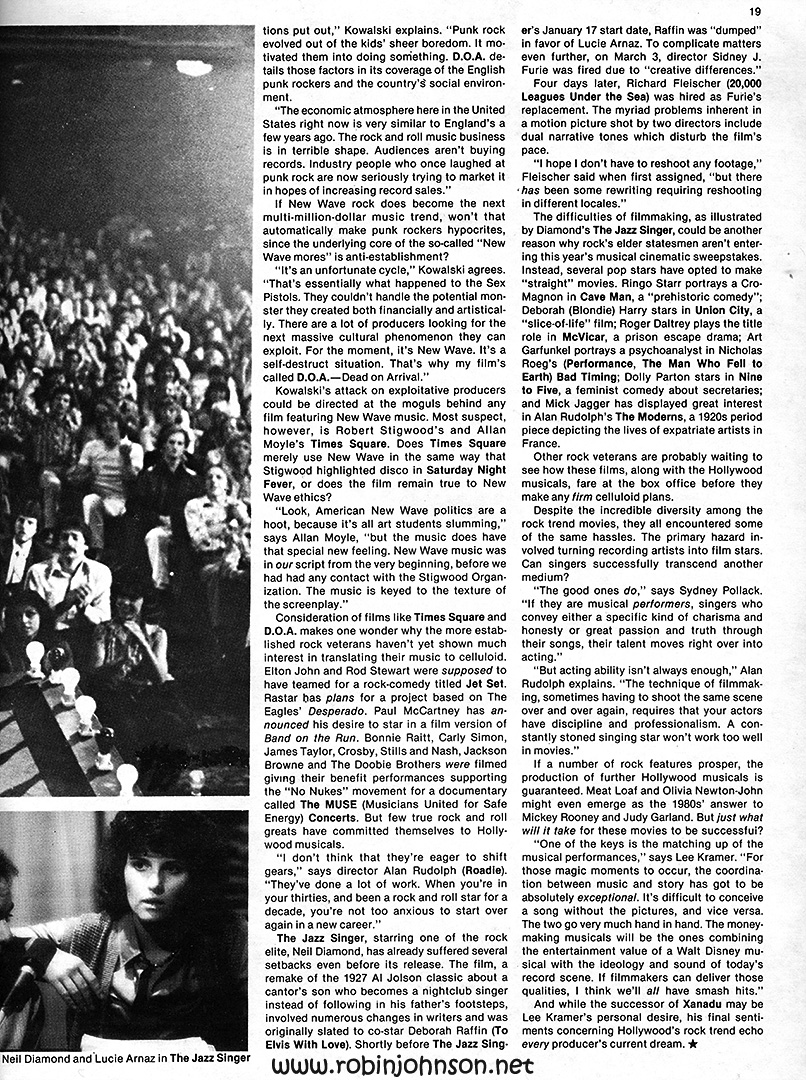
If New Wave rock does become the next multi-million-dollar music trend, won’t that automatically make punk rockers hypocrites, since the underlying core of the so-called “New Wave mores” is anti-establishment?
“It’s an unfortunate cycle,” [Lech] Kowalski agrees. “That’s essentially what happened to the Sex Pistols. They couldn’t handle the potential monster they created both financially and artistically. There are a lot of producers looking for the next massive cultural phenomenon they can exploit. For the moment, it’s New Wave. It’s a self-destruct situation. That’s why my film’s called D.O.A.—Dead on Arrival.”
Kowalski’s attack on exploitative producers could be directed at the moguls behind any film featuring New Wave music. Most suspect, however, is Robert Stigwood’s and Allan Moyle’s Times Square. Does Times Square merely use New Wave in the same way that Stigwood highlighted disco in Saturday Night Fever, or does the film remain true to New Wave ethics?
“Look, American New Wave politics are a hoot, because it’s all art students slumming,” says Allan Moyle, “but the music does have that special new feeling. New Wave music was in our script from the very beginning, before we had had any contact with the Stigwood Organization. The music is keyed to the texture of the screenplay.”
9 in (W) x 12 in (H), 72 pp (work);
1080 px (H) x 811 px (W), 96 dpi, 575 kb (image)
1080 px (H) x 880 px (W), 96 dpi, 556 kb (image)
9 in (W) x 12 in (H) (work);
1080 px (H) x 806 px (W), 96 dpi, 608 kb (image)
9 in (W) x 12 in (H) (work);
1080 px (H) x 806 px (W), 96 dpi, 628 kb (image)